Description
Keeping a Vibrant Flowerhorn Cichlid: A Practical Guide
Do you want a fish that knows you are in the room? The Flowerhorn Cichlid is that fish. These fish have big brains and big attitudes. If you own one, you know they follow you around the glass. They are not a standard goldfish or tetra. They are man-made hybrids that need specific care to thrive.
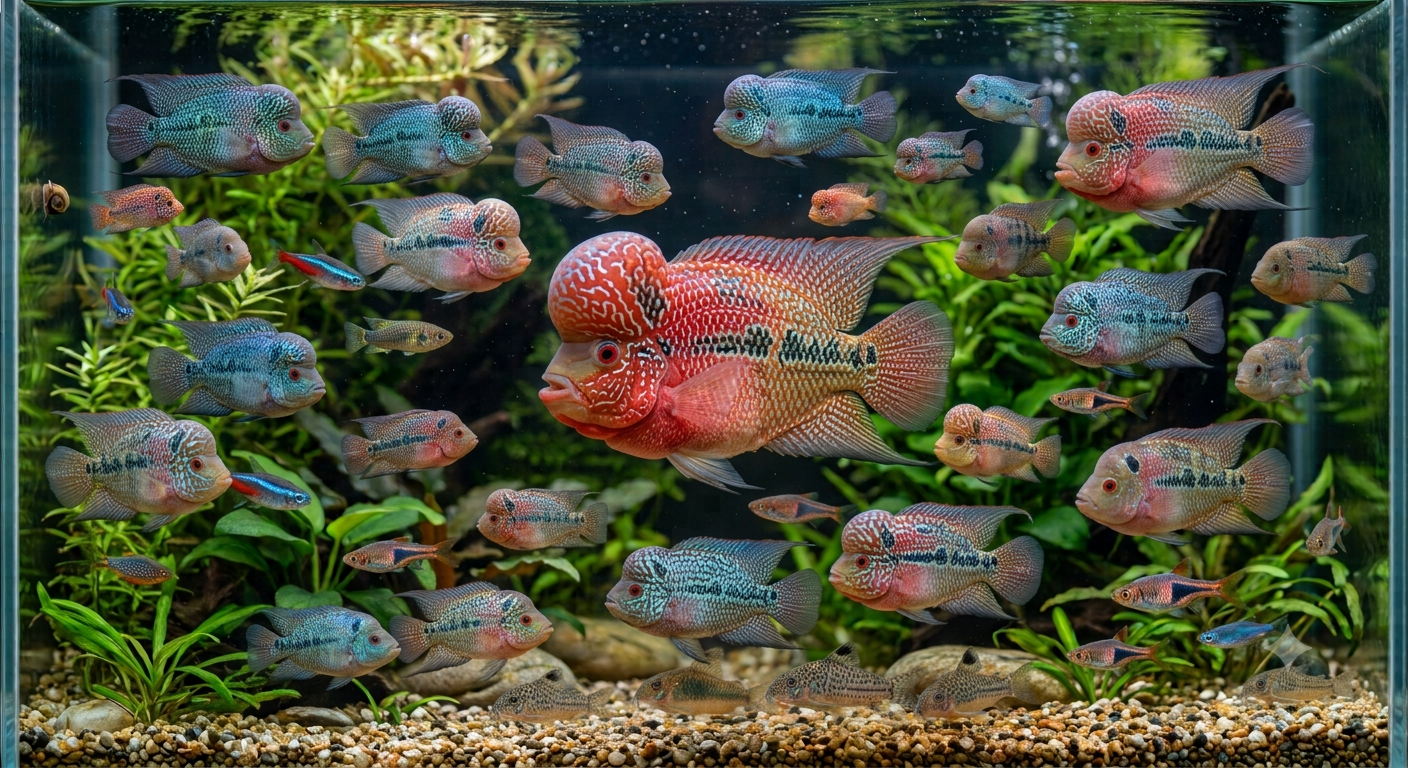
The Flowerhorn cichlid is a famous freshwater aquarium fish. They are known for their bright colors, that big bump on their head, and their bold personality. Because they were created by breeding different South American cichlids, they are unique. They have become a favorite for people who want an engaging pet. But, their needs are high. You need to understand how to keep them healthy before you bring one home.
The Origins and History of the Flowerhorn
The Flowerhorn cichlid is not found in nature. People created this fish through careful breeding. This started in Southeast Asia, mostly in Malaysia and Taiwan, around the late 1990s. Breeders wanted a fish that looked stunning and had a distinct look. They crossed various cichlid species from Central and South America. Common ancestors include the trimaculatus and certain Heros species.
Breeders worked for many generations to pick the best traits. They wanted bold colors, specific patterns, and the famous bump on the head. This bump is called a nuchal hump. It is a mass of tissue on the forehead. It is most common in males. Many hobbyists look for this feature. The shape and size of the hump can vary a lot. Some are huge, while others are smaller. It is mostly down to genetics, but good care helps the fish grow to its full potential.
Popular Flowerhorn Varieties and Their Looks
There are many different strains of Flowerhorn cichlid. Each has its own look. Here are a few you might see in shops.
The King Kamfa is a well-known strain. These fish are famous for their solid bodies and intense colors. They often have very large nuchal humps and long fins.
The Thai Silk, or SRD, is another popular choice. These fish are often a solid, bright color. Their bodies shimmer with a metallic look. They are very active and stand out in any tank.
The Zhu San is a strain with unique patterns. You might see dots or splotches on their sides. These patterns can look like calligraphy to some.
The Golden Base Flowerhorn is known for its bright gold or yellow color. These colors are quite rare and beautiful.
The colors on these fish can be amazing. You will see reds, blues, greens, and golds. Some are solid, while others have marbling. Many have iridescent scales that catch the light. The patterns can change as the fish grows. It is fun to watch how your fish develops over time.
Setting Up the Perfect Aquarium for a Flowerhorn
A Flowerhorn cichlid needs space. They are active and grow to a large size. For one juvenile, a 55-gallon tank is the absolute minimum. For an adult, you should aim for 75 to 100 gallons or more. More space is always better. These fish are very territorial. It is best to keep only one in a tank.
Filtration is critical because these fish are messy eaters. They produce a lot of waste. You need a powerful filter. A large canister filter or a sump system is best. These setups hold plenty of filter media to keep the water clean. High water flow helps remove waste quickly. Some advanced keepers even use protein skimmers.
The tank decor should be simple. These fish can be destructive. They may move gravel or knock over decorations. Use fine sand or smooth gravel on the bottom. Avoid sharp rocks or wood that could scrape their bodies. Give them lots of open room to swim.
Water quality is the secret to a healthy fish. Aim for a pH between 7.0 and 8.0. Keep the water hardness between 10 and 20 dGH. The temperature should be between 78 and 85 degrees. Test your water often. Change 25 to 50 percent of the water every week. Ammonia and nitrite must stay at zero. Nitrate should be kept low through your water changes.
Feeding Your Flowerhorn for Best Health
Your fish needs a good diet to stay colorful and active. High-quality pellets made for cichlids should be the main part of their food. These pellets are designed to give them the nutrients they need.
You should add variety to their diet. Frozen foods like bloodworms, brine shrimp, and mysis shrimp are excellent. These foods provide extra protein. Some pellets also have color enhancers. Spirulina is a common ingredient that helps with bright colors. Vitamins help keep their immune system strong.
Feed your fish small amounts 2 to 3 times a day. Only give them what they can eat in 2 to 3 minutes. Overfeeding is a big mistake. It makes the water dirty fast. It can also lead to health issues. If you notice your fish is not active or seems bloated, you might be feeding too much. Cut back on the food and do a water change to fix the problem.
Managing the Temperament of Your Flowerhorn
Flowerhorn cichlids are known for their aggression. This is especially true for males. They are very territorial and will defend their space against almost anything. They are also very smart. Many learn to recognize their owners and will come to the front of the tank to interact with you.
Because they are so aggressive, you should keep them alone. Other fish are usually not safe with a Flowerhorn. They are likely to chase, harass, or injure tank mates. Even if the other fish looks tough, the Flowerhorn will usually win. Do not try to keep them with smaller or slower fish.
Some people try to keep pairs together. This only works in very large tanks and with a lot of caution. Even then, things can go wrong. If you see signs of fighting, you must separate them right away. It is much safer and easier to keep just one Flowerhorn.
Breeding and Raising Fry
Breeding Flowerhorn cichlids is an advanced task. You need a separate breeding tank that is at least 50 gallons. The tank must have stable water conditions. A ceramic pot or a flat rock gives the pair a place to lay eggs.
You must feed the pair a high-protein diet to get them ready to spawn. Once they lay eggs, watch them closely. The parents can be aggressive toward each other after spawning.
Raising the fry takes a lot of time. The fry will live off their yolk sac at first. Then, you need to feed them tiny foods like baby brine shrimp and micro-worms. Keep the water in the fry tank very clean. It is hard work, but seeing the fry grow can be a great experience for a dedicated keeper.
Keeping a Flowerhorn cichlid is a big commitment, but it is worth it. These fish offer a bond that most other fish do not. Their intelligence and beauty make them special. By providing a large, clean tank, good food, and respecting their need for space, you can enjoy your Flowerhorn for many years. Focus on these core needs, and you will have a thriving pet in your home.
Reviews
There are no reviews yet.